By Kevin Moore
News-Chronicle
People who support campaign finance reform say that big contributions make it easier for incumbents judges to win, and that those generous donors may expect something in return.
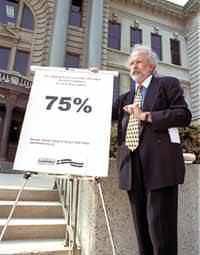
Members of Wisconsin Action Committee, a nonprofit, nonpartisan public interest group, held a press conference at the Brown County Courthouse Tuesday to tout the need for changes in campaign financing.
They cited a recent study that found incumbent state Supreme Court justices, who usually spend more on their campaigns than their opponents, won every election for state Supreme Court seats from 1989 to 1999. The study was conducted by the National Institute on Money in State Politics, based in Helena, Mont.
The group also referred to a study by Madison-based Chamberlain Research that said 77 percent of 600 people surveyed believe campaign contributions from lawyers and plaintiffs in high-profile cases influence judges' decisions in court.
"We aren't saying there is overt corruption, but the study says that public perception is undermined," said Roger Bybee, communications director of Wisconsin Citizen Action.
The study further found that 75 percent of cases before the court had parties that had made donations to judges.
"There is a tremendous potential for conflict of interest," Bybee said. "Private funding from tiny groups of people is bound to undermine public confidence in the judicial system. We need impartial funding."
Not surprisingly,, the same study showed 71 percent of those surveyed favor judicial campaign finance reform.
The state Legislature has been making some moves in that direction. The state Senate passed the Impartial Justice Bill calling for public funding of state Supreme Court elections by a 30-3 vote, but the Legislature was adjourned before the Assembly could vote on the bill.
"We should get private money out of Supreme Court elections altogether," Bybee said.
Wisconsin Citizen Action supports public funding for judicial candidates, Bybee said.
He said that if each voter contributed 25 cents, $1 million could be raised for state Supreme Court candidates running for office.
"If you don't have large personal fortunes, or wealthy donors, many qualified people feel there is no point in running," Bybee said. He said Chief Justice Shirley Abrahamson and Sharon Rose spent a combined $1.37 million in their 1999 campaigns.
"They had enormous personal fortunes they put into their campaigns," he said. Campaign finance reform has growing bipartisan support in the state Legislature, Bybee said. It also has the support of 60 state district attorneys, and 37 state judges, including Brown County Circuit Court judges J.D. McKay and Donald Zuidmulder.
Zuidmulder said he supports the election of judges, but believes campaign finance reform is called for.
"I think the independence of the judiciary is fundamental to people's confidence in the judicial institution," he said. "When we arrive at the point that significant sums of money have to be raised for judicial elections statewide it erodes the public's confidence in the impartial nature of the justices."
He said many contributors often have cases before the court, "and there is an appearance that contributions may have influenced the result," he said. "The whole issue is appearance. That's the way the system operates today, and how we elect Supreme Court justices, but that is not to say there isn't a better way to do it."
He said the reform bill would "assist the system in recruiting and electing the most qualified judicial officers."
"The system produces the public perception that people aren't getting fair treatment in court," said Samantha Sanchez, author of the Money in State Politics report. "That's unfortunate. But there is no evidence of (corruption) in Wisconsin. People have to trust the courts."
But she said there is a need for scrutiny.
"I think we need to examine systems that cause that insecurity," she said. "Courts function differently than legislatures.
"It is the one place where someone who isn't like everybody else is protected, and courts have to be free to stand up for the rights (of everyone.) We have to be sure the court will defend a person's rights, and not worry about their next campaign."
Bybee said the Impartial Justice Bill is the first of its kind in the nation, and said he hopes it will set a precedent for legislative and gubernatorial elections.



 Customized news